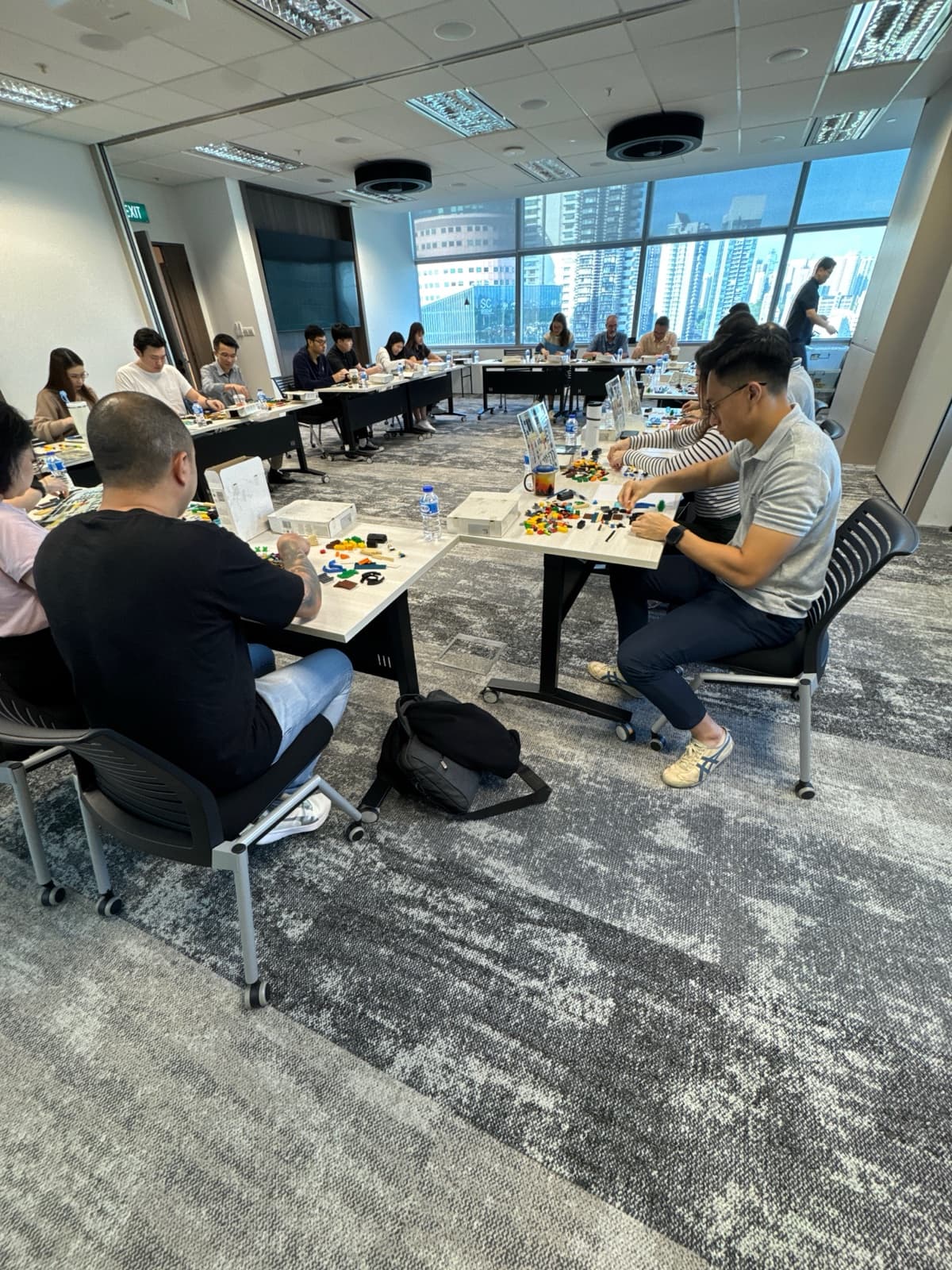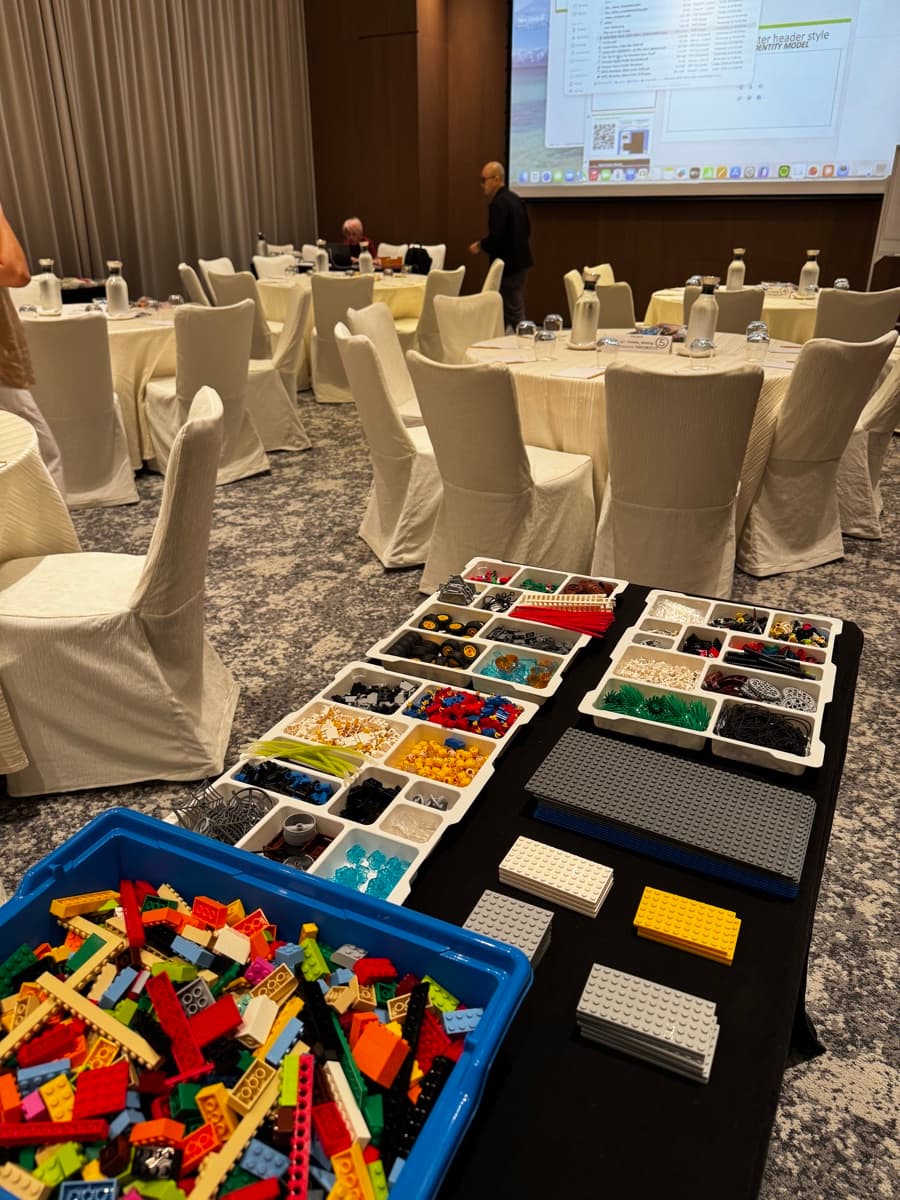
LEGO® Serious Play™ is a facilitation method in which leaders answer a hard question by building a model in bricks and explaining it. Researchers at the LEGO Group developed it with IMD professors in the late 1990s. Serious organisations use it because everyone builds, so every voice reaches the room and the team surfaces what meetings usually leave unsaid.
The first reaction is almost always the same.
A leadership team walks into the room. There are LEGO bricks on the table. Someone, usually the most senior person present, makes a joke. Something about being back in kindergarten. Something that gives everyone permission to be sceptical together.
By the end of the session, that same person is usually the one who doesn't want to stop.
This is the paradox of LEGO® Serious Play™ (LSP): it looks playful, it feels unfamiliar, and it produces some of the most honest, substantive strategic work a team can do. Understanding why it works requires understanding what it is, and what it is not.
What LEGO® Serious Play™ actually is
LSP is a facilitation methodology developed in the late 1990s by researchers at the LEGO Group in collaboration with professors from IMD Business School in Switzerland. It was not designed as a team-building exercise or an icebreaker. It was designed to solve a specific and persistent problem in organisational life: how do you get genuine strategic thinking from a group of people who have learned, over years of meetings, to perform certainty rather than explore uncertainty?
The methodology is built on a body of research in constructivist learning theory, specifically the work of Jean Piaget and his student Seymour Papert, who argued that people learn and think most effectively when they are constructing something tangible, not just talking about ideas in the abstract. When your hands are moving, your mind bypasses its filters. The internal editor goes quiet. What emerges is often more honest than what would have appeared on a slide.
In practice, participants respond to a facilitator's question by building a physical model, not a literal representation, but a metaphorical one. A leadership challenge might become a structure with a narrow bridge and a missing block. A team's culture might appear as a circle of figures facing inward. The model is then explained, and the explanation becomes the starting point for real conversation.
Why it works where conventional methods don't
Most organisational meetings follow a predictable pattern. The people with the most authority speak most. The people with the most insight often don't. Consensus forms around the comfortable rather than the true. Conflict gets smoothed over. Everyone leaves aligned on paper and privately uncertain.
LSP disrupts this pattern structurally.
Because every participant builds, and every model is discussed, everyone has an equal voice in the room. The quiet analyst who has been watching the team struggle with the same problem for six months builds a model that says exactly that. The CEO builds something that reveals an assumption the team has never spoken aloud. The model creates psychological safety because the insight comes from the object, not from the person. It is easier to challenge a structure than to challenge a colleague.
The methodology has been used by companies including NASA, Google, Toyota, Unilever, and the World Economic Forum, not because it is novel, but because it works on problems that standard approaches don't reach.
What kinds of problems it solves
LSP is particularly effective in four situations:
1. Strategic alignment, When a leadership team needs to build a shared direction but keeps talking around the real disagreements. LSP surfaces the actual mental models in the room, not the presented ones.
2. Team dynamics and culture, When a team is functioning below its potential and can't quite name why. The act of building and explaining reveals assumptions, values, and tensions that haven't found language yet.
3. Innovation and problem-solving, When conventional thinking has hit a ceiling. Physical modelling accesses lateral and associative thinking that verbal discussion rarely reaches.
4. Leadership identity and development, When an individual leader or group is navigating transition, role change, or identity questions. Building a model of "the leader I am" and "the leader I want to be" creates a clarity that talking rarely achieves as quickly.
What it is not
LSP is not therapy. It is not a team-building game. It is not an exercise in creativity for its own sake.
It is a structured facilitation process with a clear purpose, a trained facilitator, and outcomes that are as rigorous as any strategic offsite, often more so, because the honesty level is higher.
The facilitator's role is critical. LSP done well requires someone who can hold the process with authority, ask questions that genuinely open rather than lead, manage the dynamics of a room in real time, and know when a model is pointing at something the group isn't ready to say yet.
This is why certification matters. An LSP facilitator has been trained not just in the bricks, but in the methodology, in how to sequence questions, how to use individual and shared builds, how to debrief a model without flattening it, and how to translate what emerges into actionable decisions.
What a session looks like in practice
A typical half-day LSP session for a leadership team might move through four stages.
First, skills building, short, low-stakes builds that get everyone comfortable using bricks as metaphor rather than literal representation. This is where the sceptics usually shift. The first time someone builds something unexpected and articulates it clearly, the room changes.
Second, individual builds, each participant responds to the core question independently. The question might be: "Build a model of the biggest challenge your team is facing right now." Every model is shared and explained. Every voice is heard.
Third, shared model building, the group constructs a collective model that integrates the insights from the individual builds. This is where alignment actually happens, not through voting or consensus-seeking, but through the physical act of combining perspectives into something new.
Fourth, debriefing and action, what does the model tell us? What decisions can we make from here? What do we need to hold onto and what do we need to let go of? The facilitator helps the group extract commitments that are genuinely owned, not performed.
Why I use it
I came to LEGO® Serious Play™ as a sceptic. I had spent more than a decade in command environments where decisions were made under pressure with incomplete information, and the idea of bricks on a table felt like a long way from any of that.
What changed my mind was watching what happened in the room when conventional facilitation couldn't get there. A leadership team that had been having the same unresolved argument for two years built their way into a shared understanding in four hours. A senior leader who couldn't articulate what was driving his burnout built a model that said it perfectly, and used it as the starting point for the most honest conversation about his leadership he'd ever had.
The bricks are not the point. The point is what becomes possible when the usual defences come down and real thinking can happen in the open.
If your team is stuck, strategically, culturally, or in the gap between what you say and what you actually do, strategic facilitation using LSP might be exactly what the situation needs. Reach out and we can talk through whether it's the right fit.