Most people picture military leaders as rigid order-givers. Five roles across my career taught me that picture is only partly true. Authority comes from competence, readiness comes from systems, and each person needs a different style of leadership. Military leadership at its best means reading people, context and stakes, then choosing how to lead in that moment.
The most disarming thing I ever said as a Commanding Officer was this:
"I don't know. You tell me. Break it down so I can understand."
I said it to military police officers. Soldiers I had not trained with, did not share a vocation with, and who wore a different beret. I was an infantry officer commanding a military police battalion of over 500 soldiers and more than 80 working dogs. I was, in every practical sense, an outsider.
That admission, that willingness to not know, was one of the most important leadership decisions I made.
That is not the image people carry of military leaders. The stereotype is familiar. Rigid. Commanding. Unyielding. A leader who issues orders and expects compliance, who values discipline above all else, and who sees flexibility as weakness.
There is truth in that picture. But it is a partial truth. And partial truths, left unchallenged, become the lens through which entire professions are misread.
Throughout my career, I have commanded a Sniper Platoon, served as Operations Officer of a specialised counter-terrorism and public order unit, commanded a company of 130 soldiers and 47 armoured carrier vehicles, led a military police battalion as an infantry officer, and built a new department within one of Singapore's most established institutions. Each role demanded a fundamentally different version of me.
1. Leadership is not rank. It is earned.
When I commanded a Sniper Platoon, I could not simply hold a position and expect respect. Snipers are selected, trained, and tested to a standard that most soldiers will never reach. They are precise, patient, and deeply competent. They do not follow because you outrank them. They follow because you can do what they do, and then some.
That meant I had to perform. I had to plan the missions, yes. But I also had to be able to execute within them.
This maps directly to what French and Raven identified in their foundational work on social power. Expert power, the authority that comes from genuine competence, is categorically different from positional power. In high-trust, high-stakes environments, positional power alone is fragile. People follow expertise, particularly when the cost of following badly is high.
This is the first thing the stereotype misses. Military leadership at its best is not the leader standing apart from the work, issuing direction. It is the leader embedded enough in the work to be credible within it. Authority without competence breaks fast.
2. You cannot command a machine into readiness.
As a Company Commander responsible for around 130 soldiers and 47 armoured carrier vehicles, I learned that leadership is as much about systems and trade-offs as it is about people.
One instance stays with me. A brake caliper fault across several platforms. Not a dramatic failure. A mechanical reality. But the knock-on effect touched everything: mission readiness, crew safety, timeline, and the morale of soldiers who took pride in their platforms being ready.
I was not a technician. I could not fix the vehicles. What I could do was stand in the space between the engineers, the mission, and my soldiers, and hold it honestly. That meant understanding the problem well enough to ask the right questions. It meant being transparent with my soldiers about the trade-offs we were making and why. It meant advocating upward with specificity, not complaint.
Ronald Heifetz would recognise this as adaptive leadership in practice. Technical problems have known solutions. Adaptive challenges require something harder: learning, negotiation, and tolerance for uncertainty as the situation resolves itself. The leader who only knows how to give orders is genuinely useful in very few of those moments.
3. The people you lead are never who you expect.
Across my career, I have led 18-year-old conscripts completing national service, professional operators at the top of their trade, civilian specialists with decades of domain expertise, and everything in between. The age range alone spans four decades.
Hersey and Blanchard's situational leadership model makes the point well. Effective leadership is not a fixed style but a dynamic response to the level of development of the person in front of you. Applying the same approach to a first-year conscript and a 20-year veteran is not leadership. It is laziness dressed as consistency.
The military police officers I commanded were running real operations. Not exercises. Actual public-facing operations, under media scrutiny, with legal and reputational consequences, over 1,100 operations a year, more than two thousand across my two-year command. These were not people who needed to be told what to do. They needed to be trusted, developed, and led by someone who took the time to understand what they were actually dealing with.
I did not share their vocation. The most honest and effective thing I could do was listen before leading. Ask before assuming. Sit with the discomfort of not knowing, rather than projecting confidence I had not yet earned.
Edgar Schein called this humble inquiry, the discipline of asking rather than telling, of building the relationship before asserting the answer. That observation hits differently when you are an infantry officer standing in front of 500 military police soldiers on your first day.
4. Building something new inside something old.
Standing up something new inside a large, established institution is one of the hardest leadership challenges I have faced, precisely because the conventional tools of military leadership are of limited use there.
Large organisations carry weight. Culture, history, process, and the deep human instinct to protect what already works. The inertia is not malicious. It is structural. Organisational researchers such as Linda Smircich have long argued that culture is something an organisation is, rather than a variable it has.
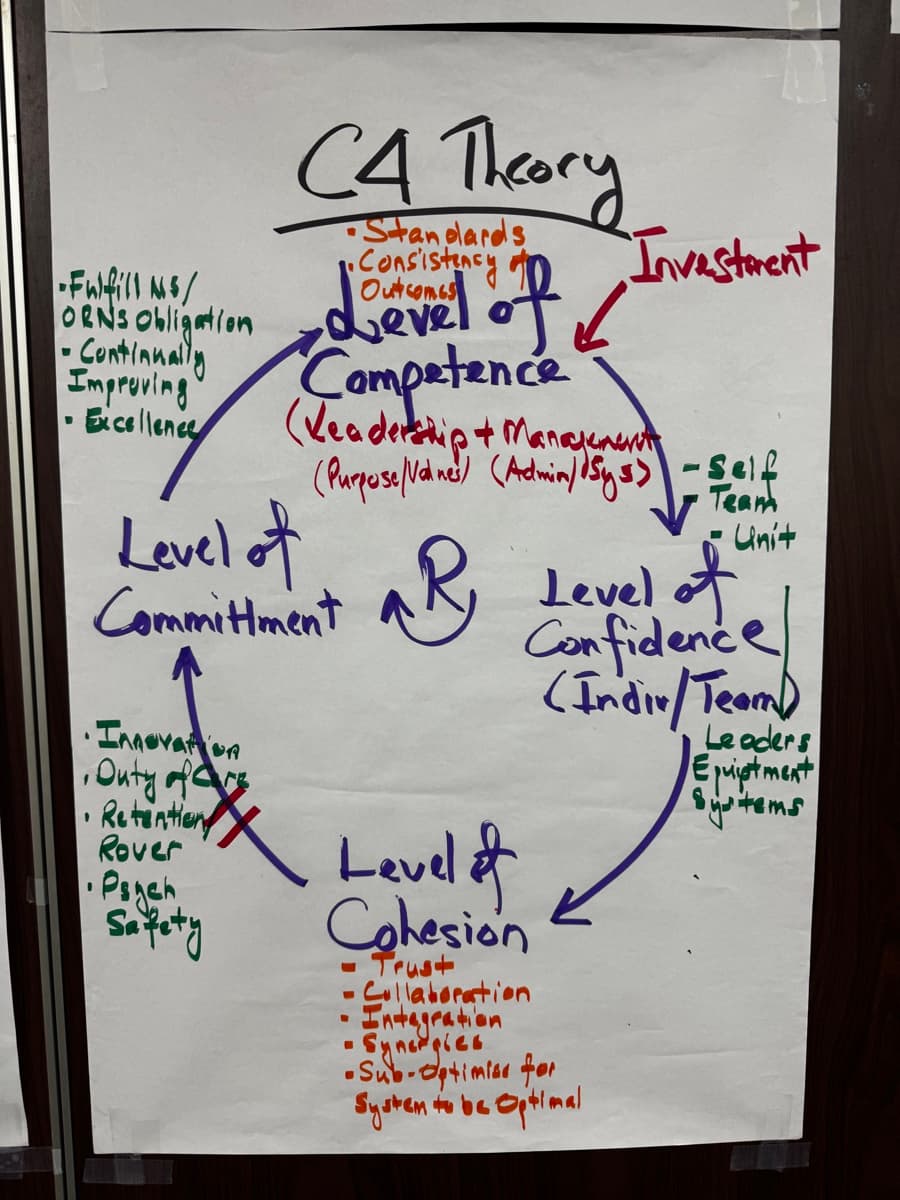
What actually works is a different kind of discipline, one built around what I think of as the PEL sequence: Performance, Experience, Learning. Most leaders and institutions fixate on performance. They want the result, and they want it quickly. But performance is the last thing that arrives, not the first.
Organisations that shortcut that loop, jumping from input to output without allowing the cycle to complete, produce activity without capability. They stay busy without growing.
5. What the career actually teaches.
The discipline of military leadership is not about command. It is about reading people, context, and stakes, and then choosing how to lead in that specific moment, with those specific people, under those specific conditions.
I have led with closeness and with distance. With direction and with questions. With certainty and with the honest admission that I did not yet know enough to decide. None of those approaches was wrong. Each was right for the situation it met.
The stereotype of the military leader is not entirely false. In the right moment, authority and clarity of command are exactly what the situation demands. But that moment is one in a much larger repertoire.
The leaders I respect most, in uniform and out of it, built that repertoire deliberately. They stayed curious longer than was comfortable. They understood that leading people is never a single method applied at scale. It is always, in the end, about the person in front of you.
A question I carry, and leave with you: What assumptions have you inherited about leadership, from the institutions you have served or the leaders who shaped you, that you have never stopped to examine?
Building that repertoire deliberately is the work I do with leaders and teams. If you want to develop it in your own people, see leadership development at Men-Kind, or start a conversation.